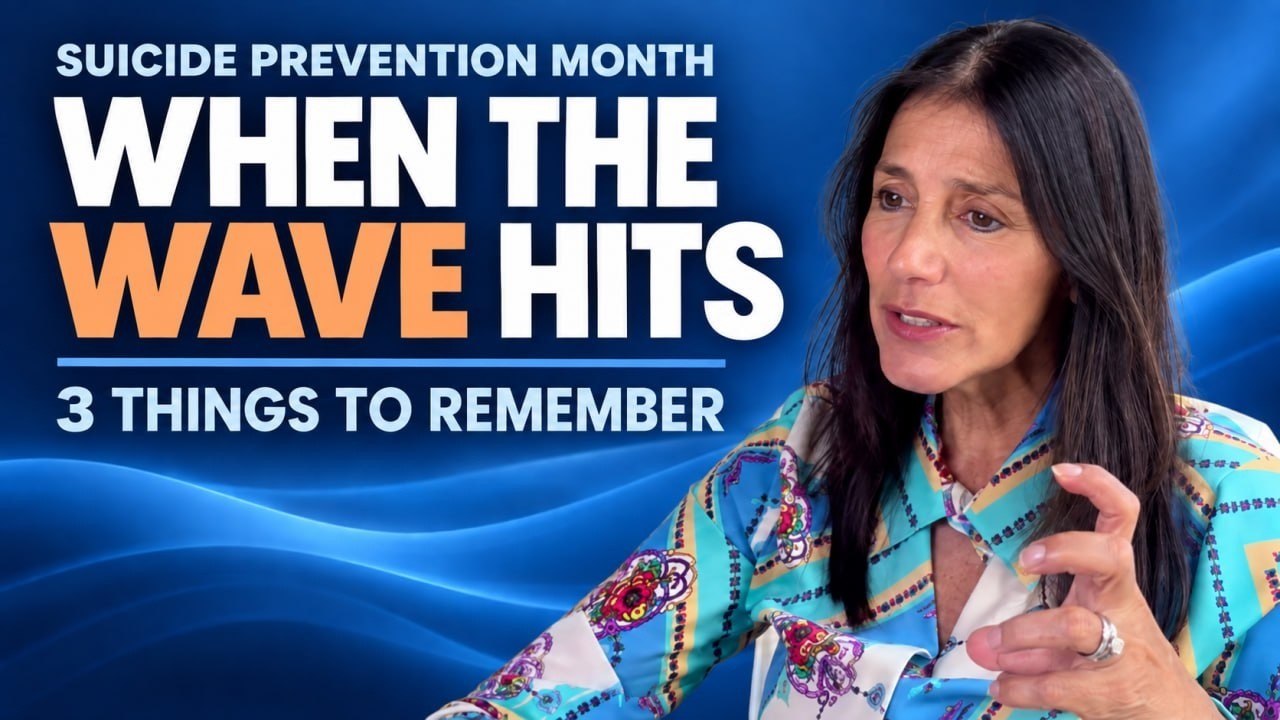
Watch My Suicide Prevention Awareness Month Message
September is Suicide Prevention Awareness Month, and this year I find myself thinking about one word in particular:
Prevention.
For more than 30 years, I have worked in the mental health field, listening to and supporting individuals and families, teaching professionals, and helping people develop skills to better understand themselves and their emotions.
Lately I have rarely been part of the suicide conversation.
My work now focuses on something that happens much earlier.
I am passionate about prevention.
When someone reaches the point where suicide feels like the only way out, immediate intervention and professional support are essential. We need trained professionals and organizations doing this lifesaving work.
But I believe suicide prevention also requires us to ask another important question:
What can we do long before someone reaches that point?
Why Suicide Prevention Matters
The numbers are difficult to ignore.
According to the Centers for Disease Control and Prevention (CDC), 48,824 people in the United States died by suicide in 2024.
But deaths tell only part of the story.
That same year, an estimated 14.3 million adults seriously considered suicide, 4.6 million made a suicide plan, and 2.2 million attempted suicide.
Behind every one of those numbers is a person. And around that person are families, friends, coworkers and communities.
This is why I believe mental health cannot only be about responding once someone is already in crisis.
Prevention has to begin earlier.
What Does Suicide Prevention Look Like Before a Crisis?
Interestingly, the CDC describes suicide prevention as something that begins long before a person experiences a suicidal crisis.
Prevention includes reducing known risk factors while strengthening protective factors.
Among the protective factors identified by the CDC are effective coping and problem-solving skills, reasons for living, supportive relationships, feeling connected to others, and access to quality healthcare.
Those are important words to me because so much of my life’s work has centered on helping people develop these kinds of skills.
I call a large part of that work emotional literacy.
Emotional Literacy Is Part of Prevention
Emotional literacy means developing the ability to recognize, understand and work with our emotions rather than simply reacting to them.
It means learning how to cope with difficult moments.
How to recognize patterns in our thinking.
How to ask for help.
How to strengthen meaningful relationships.
How to find purpose.
How to practice gratitude.
How to develop resilience.
And how to recognize that what we feel today does not necessarily determine how we will feel tomorrow.
I have often said:
Not everyone needs therapy, but everyone needs emotional literacy.
This is not a replacement for therapy, psychiatric care, crisis intervention or suicide-specific treatment when those services are needed.
It is about giving people tools earlier.
Can Happiness Be Learned?
Another phrase I have used for years is:
Happiness is a skill that can be learned.
When I say this, I don’t mean that we should be happy all the time.
That isn’t realistic, and it isn’t the goal.
Life includes grief, fear, disappointment, loss, anxiety and periods when we simply aren’t okay.
Learning happiness means developing skills that can help us navigate those experiences while continuing to build connection, meaning, purpose and hope.
One of the principles I teach through Triumph Steps® is:
What we focus on the longest grows the strongest.
What we repeatedly think about, practice and reinforce matters.
That doesn’t mean telling someone who is suffering to simply “think positively.” Mental health is far more complex than that.
It means recognizing that we can intentionally practice skills and patterns that strengthen our ability to cope with life’s challenges.
Helping People Imagine a Future They Would Love
One of my favorite exercises in Triumph Steps® is called Visit Your Future.
I don’t simply ask:
“Where do you see yourself three years from now?”
Instead, I intentionally ask:
“How would you LOVE your life to look three years from now?”
There is an important difference.
When someone is going through a difficult period, asking them simply to imagine the future may cause them to project today’s circumstances forward.
Instead, I want people to practice imagining possibility.
How would you love your relationships to look?
How would you love your health and finances to look?
What would you love to be doing?
What would give your life greater meaning?
Who would you love to become?
We don’t know exactly what the next three years will bring.
But the way life feels today does not tell us everything about what life can become tomorrow.
Sometimes we need help seeing beyond the chapter we’re currently living.
Connection Matters in Suicide Prevention
Human connection is another important part of prevention.
The CDC identifies support from family and friends and feeling connected to others among the protective factors associated with lower suicide risk.
That means prevention isn’t only something mental health professionals do.
It happens in families.
In schools.
In workplaces.
In communities.
Among friends.
Sometimes it begins with noticing someone.
Listening.
Checking in.
Asking another question instead of assuming someone is okay.
And helping people know that seeking professional support is a sign that something needs attention—not something that needs to be hidden.
Bringing the Conversation to the Legal Profession
This year, I was especially proud to be part of a program with attorney Bruce Simpson addressing attorney mental health, well-being and ethics.
It was meaningful to bring these conversations into the legal profession because prevention belongs in our workplaces and professional communities too.
People don’t leave their emotional lives at the office door.
High-pressure professions can benefit from conversations about coping, connection, mental health, emotional well-being and knowing when to seek additional help.
The experience reinforced something I have believed for a long time:
We should not wait for a crisis to begin talking about mental health.
Let’s Make Prevention Part of Everyday Life
During Suicide Prevention Awareness Month, we need to talk about warning signs, crisis resources and how to respond when someone may be suicidal.
But I hope we will also broaden the conversation.
Let’s talk about what happens before the crisis.
Let’s teach emotional literacy.
Let’s teach coping and problem-solving skills.
Let’s strengthen relationships and human connection.
Let’s help people discover meaning and purpose.
Let’s give children these skills before they become struggling adults.
And let’s remind people that a painful moment—even an extraordinarily painful one—is a moment in a much larger life story.
There may be relationships they haven’t formed yet.
Places they haven’t visited.
People they haven’t met.
Purpose they haven’t discovered.
And versions of themselves they haven’t had the opportunity to become.
What we focus on the longest grows the strongest.
Let’s intentionally strengthen connection, resilience, meaning, hope and the skills that help us navigate life.
Because I continue to believe something I have spent much of my career teaching:
Happiness is a skill that can be learned.
If you or someone you know is experiencing emotional distress or a suicidal crisis in the United States, call or text 988 to reach the Suicide & Crisis Lifeline.
By Beatriz Martinez-Peñalver, LMHC, QS | Founder of Triumph Steps® and Co-Founder of Healthy Connections, CMHC